
Mental Maths for Kids: Fun Activities to Improve Calculation Speed
Mental maths helps children solve mathematical problems in their minds without always relying on paper, pencils or calculators. From simple addition and subtraction to number bonds and multiplication, regular practice can help children develop stronger number sense and become more confident with calculations.
However, mental maths is not just about answering questions quickly. Children also need to understand number relationships, choose suitable strategies and check their answers. When practice feels like a game rather than a test, children are more likely to enjoy learning.
At Ninjas Bookland, parents can explore maths activity books, number bonds workbooks and mental maths resources for young learners.
What Is Mental Maths and Why Is It Important?
Mental maths is the ability to calculate using number facts and mathematical strategies without writing down every step. For example, to solve 18 + 7, a child can add 2 to make 20 and then add the remaining 5 to get 25.
Regular practice helps children understand numbers, improve addition and subtraction skills, develop problem-solving abilities and apply mathematics to everyday situations.
Mental maths also builds confidence. When children understand different ways to solve a problem, they can attempt calculations more independently instead of relying only on memorised answers.
At What Age Should Children Start Mental Maths?
Children can begin exploring numbers before formal schooling. The activities should match their age and understanding.
Preschoolers can practise counting toys, recognising numbers and comparing small groups. Children aged 4–6 can gradually explore number bonds and simple addition, while primary-school students can practise larger calculations, place value, multiplication facts and number patterns.
These are general guidelines rather than strict milestones. Allow children to progress at their own pace and revisit basic concepts whenever necessary.
10 Fun Mental Maths Activities to Improve Calculation Speed
1. Number Bond Challenge
Number bonds show how numbers combine to make a total. For example, 3 + 7 = 10 and 4 + 6 = 10.
Choose a target number, such as 10, and ask your child to find different pairs that make it. Once they understand the concept, introduce number bonds to 20.
This activity strengthens number sense and provides a foundation for addition and subtraction.
2. Quick Addition Game
Ask your child to solve simple questions such as 3 + 4, 6 + 3 or 8 + 2. Beginners can use their fingers or objects before gradually attempting calculations mentally.
Take turns asking questions and let your child challenge you, too. This makes practice interactive while helping children become familiar with addition facts.
3. Subtraction With Everyday Objects
Place eight counters or toys on a table and ask your child to count them. Remove three and ask how many remain.
As your child becomes more confident, introduce questions such as 9 − 2 or 12 − 3 without using objects. This activity helps children understand subtraction and its relationship with addition.
4. Count Forwards and Backwards
Practise counting from 1 to 20, counting backwards from 10, or starting at 5 and counting forward to 15. Older children can practise skip counting in twos, fives and tens.
These games strengthen number sequences and prepare children for addition, subtraction and multiplication.
5. Make Ten in Different Ways
Learning to make 10 is useful for solving calculations efficiently. Ask your child what number must be added to 6 to make 10, or how much more 8 needs to reach 10.
You can also demonstrate that 9 + 4 can be solved by adding 1 to 9 to make 10, then adding the remaining 3. The answer is 13.
This strategy helps children understand how numbers can be split into smaller parts to simplify calculations.
6. Missing Number Game
Missing-number questions encourage children to think about number relationships. Try questions such as 4 + __ = 10, __ + 3 = 8 or 9 − __ = 5.
Let your child use objects or drawings when needed. As their understanding improves, introduce larger numbers and encourage them to explain their reasoning.
7. Dice Addition and Subtraction
Roll two dice and ask your child to add the numbers. For subtraction, subtract the smaller number from the larger number.
Take turns rolling the dice and answering questions. This simple game provides variety and makes repeated calculations more enjoyable.
8. Double and Near-Double Challenge
Help children learn doubles such as 4 + 4 = 8 and 6 + 6 = 12. Once they understand these facts, introduce near-doubles.
For example, 6 + 7 can be solved by calculating 6 + 6 = 12 and adding 1 to get 13. This helps children use familiar facts to solve new problems.
9. Mental Maths Shopping Game
Create a pretend shop using household objects and simple prices. For example, a pencil costs ₹5 and an eraser costs ₹3. Ask your child to calculate the total cost.
You can also ask how much remains if they have ₹10 and spend ₹4. This connects addition and subtraction with everyday situations.
10. Number Pattern Detective
Give your child a sequence such as 2, 4, 6, 8, __ or 20, 18, 16, __. Ask them to identify the pattern and predict the next number.
Encourage your child to explain the rule rather than simply provide the answer. This develops logical thinking and number awareness.
How Parents Can Improve Their Child's Mental Maths Skills
Parents can support learning by practising for a few minutes every day and choosing questions that match their child's current abilities. Begin with familiar calculations and introduce slightly harder challenges as confidence improves.
Encourage children to explain how they found an answer. Questions such as “Can you solve it another way?” or “How can you check your answer?” help them understand the methods they use.
Mistakes should be treated as learning opportunities rather than reasons for criticism. Balance speed with accuracy and understanding. Timed games may be enjoyable for some children, but avoid making them feel pressured to answer quickly.
Choosing the Right Mental Maths Activity Books for Kids
A suitable maths activity book can help parents organise practice and introduce concepts gradually. Choose a resource that matches your child's learning level and includes clear instructions, appropriate exercises and opportunities to practise number sense, number bonds, addition and subtraction.
Visual examples and simple word problems can be especially helpful for younger learners. Check the product description and syllabus coverage before purchasing to ensure that the book suits your child's needs.
Recommended Maths Activity Books at Ninjas Bookland
Parents can explore the Maths Books collection at Ninjas Bookland for resources that support early mathematical learning.
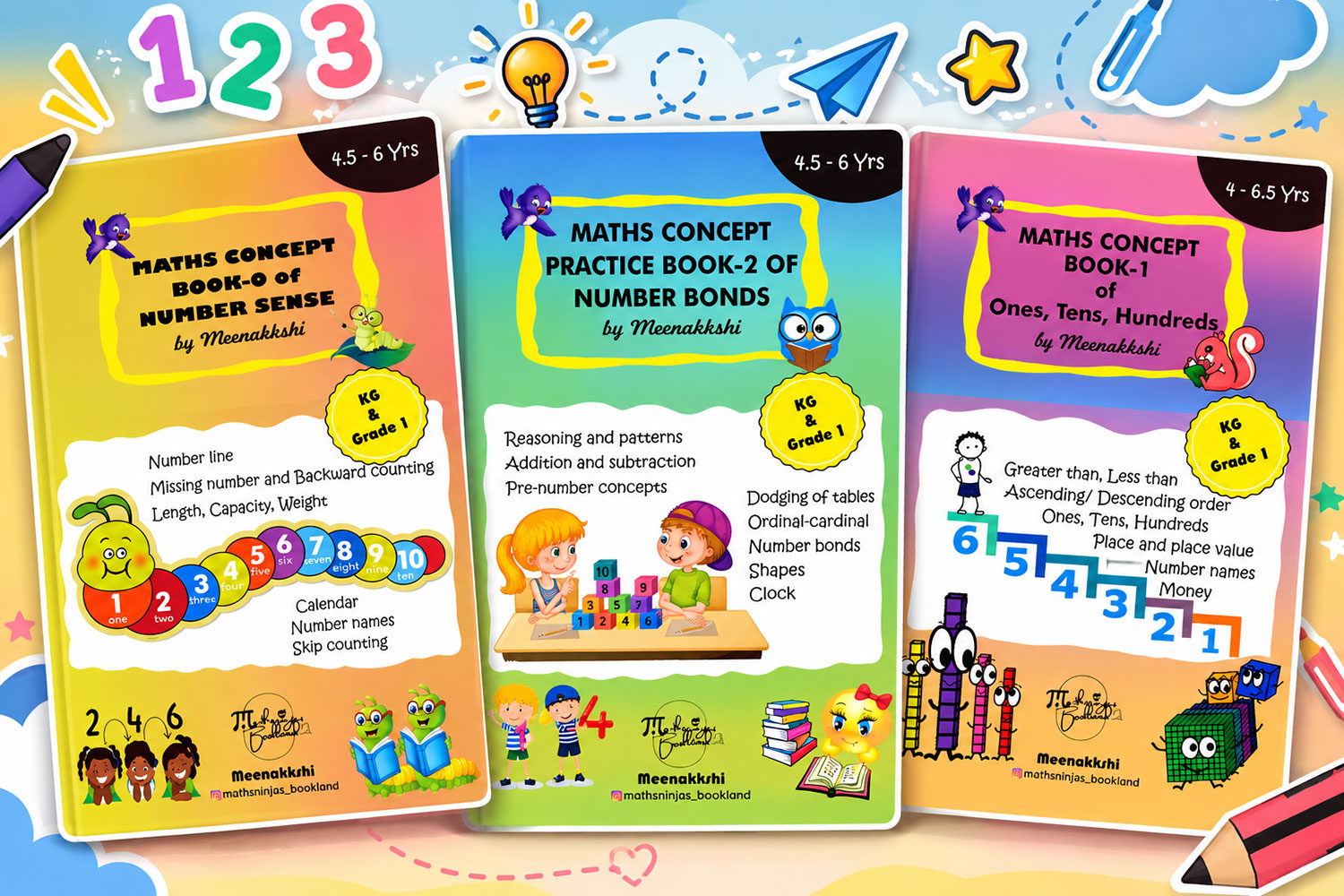
The available listings include the Mental Math Concept Activity Book of Number Bonds for Addition and Subtraction, which focuses on foundational number relationships, and the Kindergarten/UKG Maths Concept Book of Number Sense, which covers number sense and basic calculations.
For children ready for more structured practice, the UKG/Grade 1 Mental Maths Activity Book: Ones, Tens and Hundreds introduces place value concepts. Ninjas Bookland also lists a Class 1 Maths Practice Workbook With Mental Maths and a Grade 2 Maths Workbook with additional calculation exercises.
Review the current product descriptions before purchasing and select a book that matches your child's abilities and school curriculum.
A Simple 7-Day Mental Maths Practice Plan
| Day | Activity |
|---|---|
| Monday | Number bonds to 10 |
| Tuesday | Dice addition game |
| Wednesday | Subtraction using toys or counters |
| Thursday | Make-ten addition practice |
| Friday | Missing-number challenge |
| Saturday | Pretend shopping game |
| Sunday | Review favourite number games |
Start with around 5–10 minutes per session and adjust the duration according to your child's attention span and interest. This is a flexible example rather than a strict timetable.
Common Mistakes to Avoid When Teaching Mental Maths
Avoid focusing only on speed, introducing difficult questions too early or making practice sessions too long. Children need time to understand concepts before attempting more challenging calculations.
Do not compare children with their siblings or classmates. Every child develops at a different pace. Instead, combine worksheets with games, everyday activities and opportunities to explain mathematical thinking.
